

Best Brewing Methods for Single Origin Beans
Last Updated: November 12, 2026
Quick Summary
The best brewing methods for single origin beans are the ones that let a specific lot taste like where it grew, so match the method to the bean: pour-over for clarity and delicate floral lots, French press for body in medium and medium-dark roasts, and drip for everyday consistency. Start at a 1:16 coffee-to-water ratio by weight and adjust from there.
- Immersion brewing favors body while percolation favors clarity, so neither method is better.
- Bloom pour-over coffee with roughly twice the grounds' weight in water and pause 30 to 45 seconds.
- French press uses a coarse grind and a four-minute steep, then decant the whole batch to avoid bitterness.
- Start at 1:16 by weight, about 18 grams of coffee to 290 grams of water per mug.
- Light roasts are denser and need a finer grind and hotter water than porous dark roasts.
Table of Contents
- How Single Origin Beans Change the Brewing Equation
- The Best Pour-Over Method for Single-Origin Coffee
- Single-Origin Coffee French Press: Full Immersion, Full Body
- Single-Origin Coffee Drip Brewing for Everyday Consistency
- The Coffee-to-Water Ratio for Brewing Single Origin Beans
- Matching Grind Size and Roast Profile to Your Beans
- Water Chemistry and Sensory Evaluation: The Details That Decide the Cup
- Build Your Single Origin Brewing Kit with Al Di Là
- Frequently Asked Questions
How Single Origin Beans Change the Brewing Equation
Single origin beans are coffees traced to one farm, cooperative, or region rather than blended from multiple sources, and that traceability changes how you should brew them.
The best brewing methods for single origin beans are the ones that let a specific lot taste like where it grew.
Below, we break down the methods that actually respect a single origin, the ratios that keep them balanced, and the details most guides skip.
Immersion vs. Percolation: Two Paths to the Same Cup
Immersion brewing steeps grounds fully in water, as a French press does, while percolation passes water through a bed of coffee, as pour-over and drip do.
In immersion, the slurry sits still. Water has time to pull oils and fine particles into the cup, which builds mouthfeel and rounds off sharp edges.
Neither is better. A delicate floral Ethiopia often shines with percolation. A medium-dark Honduras with caramel and brown sugar notes rewards immersion.
Why Flavor Clarity and Body Depend on Your Method
Clarity and body are the two levers every brewer is actually pulling. Clarity is how distinctly you taste individual notes: the pear, the jasmine, the strawberry. Body is the weight and texture on your tongue.
Filter paper traps oils and sediment, so percolation with a paper filter delivers clarity. Metal mesh and full immersion let those oils through, which is why French press feels heavier and coats the palate.
The Best Pour-Over Method for Single-Origin Coffee
A common pour-over approach is a bloom of roughly twice the coffee's weight in water, a short pause, then a slow spiral pour to finish.
Here is how we would run it:
- Rinse the filter paper with hot water to remove paper taste and preheat the vessel.
- Add medium-fine grounds, roughly the texture of table salt.
- Pour just enough water to saturate the bed, about twice the grounds' weight.
- Wait 30 to 45 seconds for the bloom to settle. Fresh coffee releases gas here.
- Pour in slow spirals, keeping the water level steady, until you hit your total weight.
- Let it draw down fully. Total brew time lands around 2:30 to 3:30.
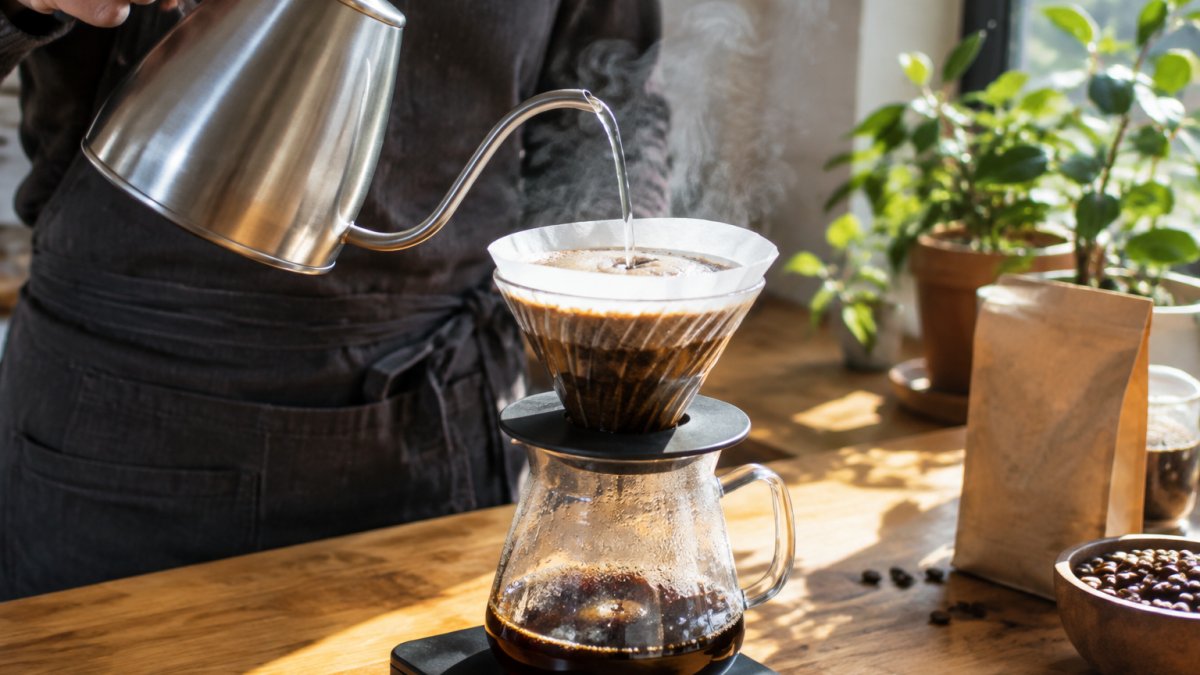
Keep agitation gentle. A rough pour pushes fines to the filter and stalls the draw-down. For a beginner-friendly walkthrough of ratios, see our guide on how to brew pour over coffee ratio for beginners.
Single-Origin Coffee French Press: Full Immersion, Full Body
Single-origin coffee French press brewing gives you a rich, textured cup from beans that lean toward chocolate, caramel, or dried fruit. No paper filter is needed.
Use a coarse grind, closer to sea salt than table salt.
The tradeoff is sediment. French press lets fine particles through, so the last sip is always cloudy. That is the point.
Best for: medium and medium-dark roasts with cocoa, spice, or brown sugar notes. Skip if: you are brewing a delicate floral lot you want to taste clean.
Single-Origin Coffee Drip Brewing for Everyday Consistency
Single-origin coffee drip brewing can offer consistency, since a batch brewer holds temperature and timing steady.
The catch is control. Most drip machines run a fixed cycle, so you dial in with grind size and ratio instead of technique. Grind slightly coarser than you would for pour-over, and check that your machine reaches the right water temperature rather than lukewarm. A machine that brews too cool under-extracts, and single origins punish under-extraction with sour, hollow cups.
The Coffee-to-Water Ratio for Brewing Single Origin Beans
The coffee-to-water ratio for brewing single origin beans should start at 1:16 by weight and adjust from there.
Why weight and not scoops? Volume varies wildly with grind and bean density. A scale removes the guesswork and makes your results repeatable.
- 1:15 for a stronger, heavier cup, good for immersion methods
- 1:16 as the neutral starting point for most origins
- 1:17 for a lighter, tea-like cup that highlights delicate floral notes
Change one variable at a time. If a cup tastes weak and sour, tighten the ratio or grind finer. If it tastes bitter and drying, loosen the ratio or grind coarser.
Matching Grind Size and Roast Profile to Your Beans
Grind size and roast profile have to move together, and for single origins the bean's density adds a third variable. Light roasts are denser and less soluble, so they need a finer grind and hotter water to extract fully. Dark roasts are more porous and extract fast, so a coarser grind keeps them from turning bitter. Density itself varies by origin and altitude: high-grown beans are denser and resist extraction, while lower-grown beans are less dense and give up their solubles more readily.
A Calibration Matrix by Origin and Process
Use this as a starting point, then adjust one notch at a time based on taste. Grind descriptions assume a burr grinder; blade grinders produce too many fines to calibrate reliably.
- High-altitude washed, light roast (for example, an Ethiopia or Kenya grown well above 1,700 meters): medium-fine grind, water just off the boil, and expect a longer draw-down. These beans are dense and need the extra contact time and heat to show their acidity and florals.
- High-altitude natural, light to medium-light roast: medium grind with slightly cooler water to protect the fruity fermentation notes from turning boozy or bitter.
- Mid-altitude washed, medium roast (for example, a Colombia or Costa Rica): medium grind at standard brew temperature; this is the most forgiving combination and a good baseline for dialing in a new grinder.
- Lower-altitude natural or pulped natural, medium roast (for example, a Brazil): medium to medium-coarse grind. Lower density plus a natural process means these beans extract quickly, and a finer grind pushes them toward bitter and muddy.
- Medium-dark roast of any origin: medium-coarse grind to slow extraction and keep the roast's cocoa and spice notes from tipping into ash.
Reading the Cup to Adjust the Grind
The matrix gets you close; the cup tells you which way to move. If the brew runs fast and tastes sour, thin, or salty, the grind is too coarse or the dose too low, and extraction is incomplete.
Roast date matters here too. If you want to understand how freshness shifts your grind settings, read 7 ways roast date shapes your coffee extraction.
Use this calibration matrix as a starting point, then adjust one notch at a time based on taste.
| Bean type | Grind | Water and notes |
|---|---|---|
| High-altitude washed, light roast (Ethiopia, Kenya above 1,700 m) | Medium-fine | Water just off the boil; expect longer draw-down |
| High-altitude natural, light to medium-light roast | Medium | Slightly cooler water to protect fruity notes |
| Mid-altitude washed, medium roast (Colombia, Costa Rica) | Medium | Standard brew temperature; most forgiving baseline |
| Lower-altitude natural or pulped natural, medium roast (Brazil) | Medium to medium-coarse | Lower density extracts quickly; finer grind turns bitter |
| Medium-dark roast of any origin | Medium-coarse | Slows extraction; keeps cocoa and spice from turning ashy |
Water Chemistry and Sensory Evaluation: The Details That Decide the Cup
Coffee is roughly 98 percent water, so the minerals dissolved in that water shape what the brewer actually extracts and what the tongue perceives. This is the detail most single-origin guides skip, and it matters more for single origins than for blends because a blend is built to taste consistent across a range of conditions while a single lot has one narrow expression to protect.
What the Minerals Actually Do
Two measurements drive most of the effect: total dissolved solids (TDS) and alkalinity. TDS is the overall mineral load; alkalinity is the water's capacity to buffer acids. Most practitioners find a brew water in the range of roughly 75 to 150 ppm TDS works well for single-origin coffee, with alkalinity kept low, often under about 50 ppm as calcium carbonate.
- High alkalinity neutralizes the bright acids that define washed high-grown lots. A Kenya or an Ethiopia that should taste of citrus and blackcurrant goes flat and chalky. The acidity is still in the bean; the water is buffering it out of perception.
- High hardness with low alkalinity can push extraction and sharpen acidity, which flatters some lots and makes others harsh.
- Distilled or reverse-osmosis water with near-zero minerals extracts poorly and tastes hollow because there is little calcium and magnesium to bind flavor compounds and carry them into the cup. Magnesium in particular is associated with pulling fruity and acidic notes forward.
- Very hard tap water mutes acidity and muddies flavor, and it also scales kettles and brewers, which changes temperature stability over time.
A simple carbon filter on your tap removes chlorine and off-flavors without stripping minerals, and it is usually enough. If your tap is very hard or very soft, blending a small amount of mineral-rich water into filtered or reverse-osmosis water is the common fix.
Tasting Deliberately
Sensory evaluation is the practice of tasting coffee systematically rather than just drinking it, and it is how you tell whether a problem is the water, the grind, or the bean.
Use the flavor language as a diagnostic. If a lot described as floral and citrus tastes muddy and savory, suspect high alkalinity or over-extraction.
For a broader look at dialing in your setup, our complete guide to improving home coffee brewing covers the fundamentals beyond this article.
Build Your Single Origin Brewing Kit with Al Di Là
A brewing kit is only as good as the beans going into it. We roast to order, and our oxygen-free capsule sealing is designed to protect freshness.
Start with our single origin lineup to pick beans that match your preferred method. If you want to compare across brewing styles before committing, the Single Origin Favorites Sample Pack at $25.99 gives you six 2-ounce packs, from a medium Brazil Santos with cocoa notes to a medium-light Tanzania with pear and jasmine.
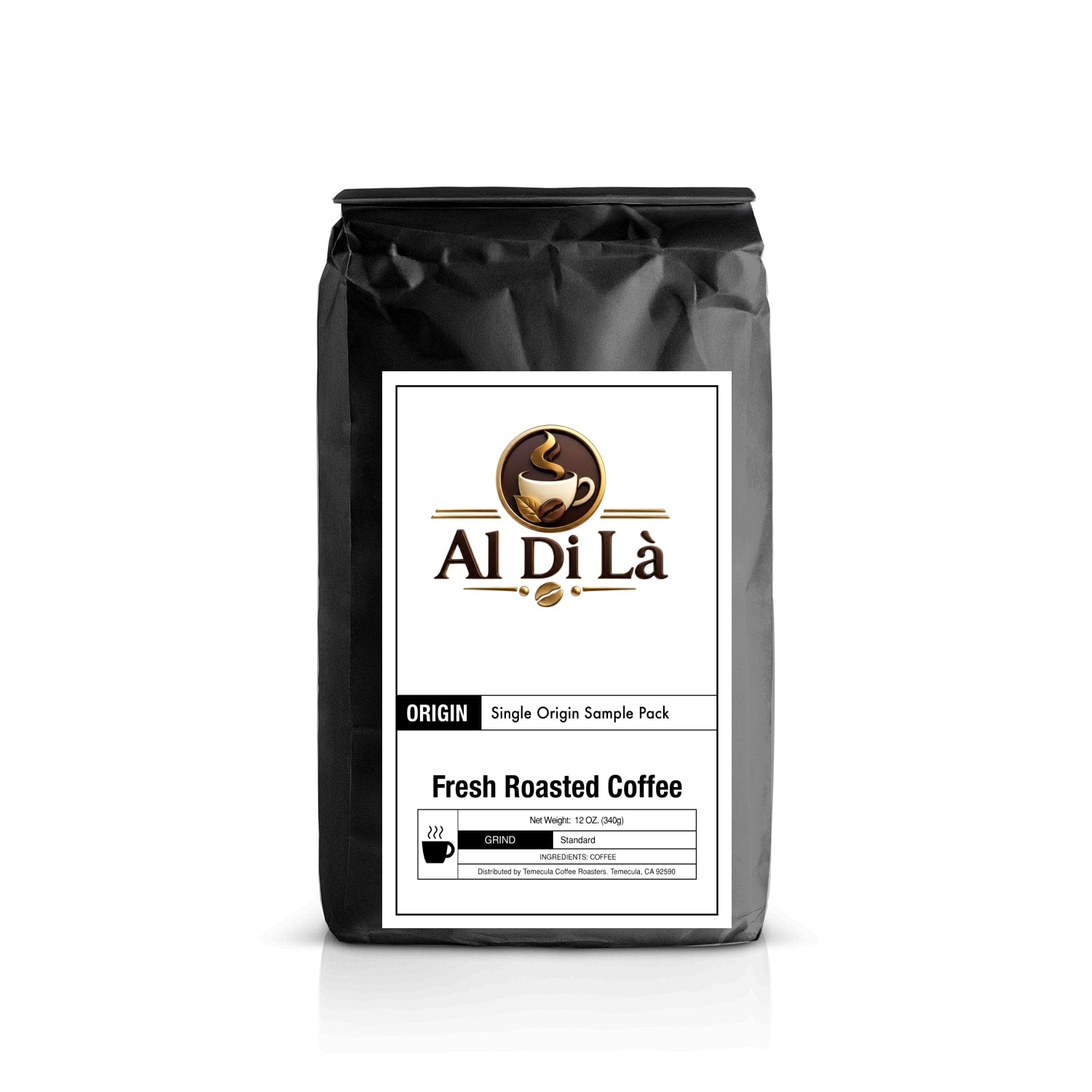
For a delicate, tea-like cup, our Ethiopia Natural at $24.99 brings milk chocolate, fruity, and caramel notes from Sidama.
Ordering is simple.
The hardest part of single origin brewing is not technique. It is freshness.
Get started with Al Di Là and taste what a fresh-roasted single origin does for your morning ritual.
Frequently Asked Questions
Which brewing method is best for single-origin beans?
There is no single winner. Pour-over and French press are both common ways to brew single origin beans, and the method you choose changes how the cup tastes.
What grind size should I use for single-origin coffee?
Start medium-fine for pour-over, about the texture of table salt, and medium-coarse for French press, closer to sea salt. Drip machines usually want a medium grind. Adjust from there: if the cup tastes sour and thin, grind finer; if it tastes bitter and dry, grind coarser. Light roasts often need a finer grind than dark roasts to extract fully.
Is French press or drip coffee better for single-origin beans?
French press produces a fuller-bodied cup with more sediment, while drip brewing produces a cleaner cup. Choose the method that suits your taste.
What is the coffee-to-water ratio for brewing single origin beans?
A reliable starting point is 1:16, meaning 1 gram of coffee to 16 grams of water. For a 10-ounce cup, that is roughly 18 grams of coffee and 290 grams of water. Stronger palates often prefer 1:15; lighter, tea-like cups come from 1:17. Weigh your coffee and water in grams for repeatable results, then adjust one variable at a time.
Does pour-over bring out more flavor in single-origin coffee?
Pour-over gives you control over agitation, bloom, and draw-down time. The trade-off is attention: a pour-over demands a steady hand and about four minutes.
