

How to Tell if Coffee Beans Are Fresh
Table of Contents
- Why Freshness Matters for Your Coffee
- Check the Roast Date vs Expiration Date
- Visual Inspection: What Fresh Beans Look Like
- The Aroma Test for Freshness
- Perform the Coffee Bloom Test During Brewing
- How to Store Coffee Beans for Maximum Freshness
- Taste Profile Indicators of Stale Coffee
- Frequently Asked Questions
Last Updated: October 2, 2026
Why Freshness Matters for Your Coffee
The difference between fresh and stale coffee is night and day. Fresh roasted coffee beans deliver vibrant aroma, complex flavor, and smooth body. Stale beans taste flat, hollow, and one-dimensional.
Freshness directly impacts extraction. When you brew fresh beans, the flavors come through clean and balanced. With stale beans, you're fighting against oxidation and CO2 loss from the moment the water hits the grounds.
At Al Di Là, we roast coffee to order specifically because freshness matters this much. The richness, the sweetness, the body, it all improves dramatically when you start with beans that are actually fresh.
The challenge is knowing what fresh looks like. Most people have never seen truly fresh beans. They've only experienced what sits on shelves for weeks or months. This guide walks you through exactly how to tell if coffee beans are fresh, so you can spot the difference yourself.
Check the Roast Date vs Expiration Date
The roast date is your most reliable freshness indicator. Look for a date printed or stamped on the bag. This tells you when the beans were roasted.
Fresh coffee is best within 2-4 weeks after roasting. This is the optimal freshness window. The beans still have vibrant aroma and the flavor profile hasn't started to degrade.
Here's the critical distinction: roast date ≠ expiration date. Many bags show an expiration date that's months away. That doesn't mean the beans are fresh. A bag roasted 6 months ago with an expiration date 3 months in the future is stale, period.
What to look for:
- Roast date within the last 2 weeks (ideal)
- Roast date within the last 4 weeks (acceptable)
- Roast date older than 8 weeks (likely stale)
If a bag has no roast date visible, that's a red flag. The roaster isn't confident in freshness, or they're hiding how long the beans have been sitting. Skip it.

When you order from Al Di Là, the roast date is recent because we roast to order. Your beans ship within days of roasting, not months later.
Visual Inspection: What Fresh Beans Look Like
Fresh roasted coffee has a distinct appearance, but what you're looking for depends on the roast level and processing method. Understanding this context separates casual observation from expert evaluation.
Fresh beans show:
- Rich, vibrant color (deep brown to nearly black, depending on roast level)
- Oily or glossy surface (this is CO2 and natural oils, not a flaw)
- Uniform appearance across the batch
- Visible texture and detail on the bean surface
Stale beans show:
- Dull, matte finish (no shine or gloss)
- Faded color (greyish or washed-out brown)
- Visible cracks or fractures in the bean
- Uneven coloring or patchy appearance
Why roast level matters for freshness assessment:
Light roasts have minimal surface oil because the beans are removed from heat before oils migrate to the surface. A light roast bean that appears completely matte isn't necessarily stale, it's normal. Instead, look for color: fresh light roasts are tan to light brown with visible detail. Stale light roasts fade to a pale, washed-out tan.
Medium roasts show moderate oil and deeper brown color. Fresh medium roasts have a glossy sheen and even coloring. Stale medium roasts lose that sheen and appear dull.
Dark roasts have the most visible oil because extended roasting time pushes oils to the surface. A dark roast should look almost wet with oil when fresh. If a dark roast appears dry or patchy, it's likely stale or was roasted weeks ago.
Processing method affects appearance too:
Washed coffees (the most common method) tend to have cleaner, more uniform color because the fruit is removed before drying. Fresh washed beans show consistent brown tone with visible oil on medium and dark roasts.
Natural process coffees (dried with the fruit still attached) often have a slightly darker, more varied appearance even when fresh, because the fruit sugars caramelize during drying. Fresh natural process beans still show oil on the surface and vibrant color, but expect less uniformity than washed beans.
The side-by-side test:
If you're uncertain, the most reliable visual assessment is comparison. If you have access to a bag you know is fresh (roasted within 2 weeks), place a few beans next to beans from a bag you're evaluating. The difference becomes obvious: fresh beans look alive with color and sheen. Stale beans look tired and faded, regardless of roast level.
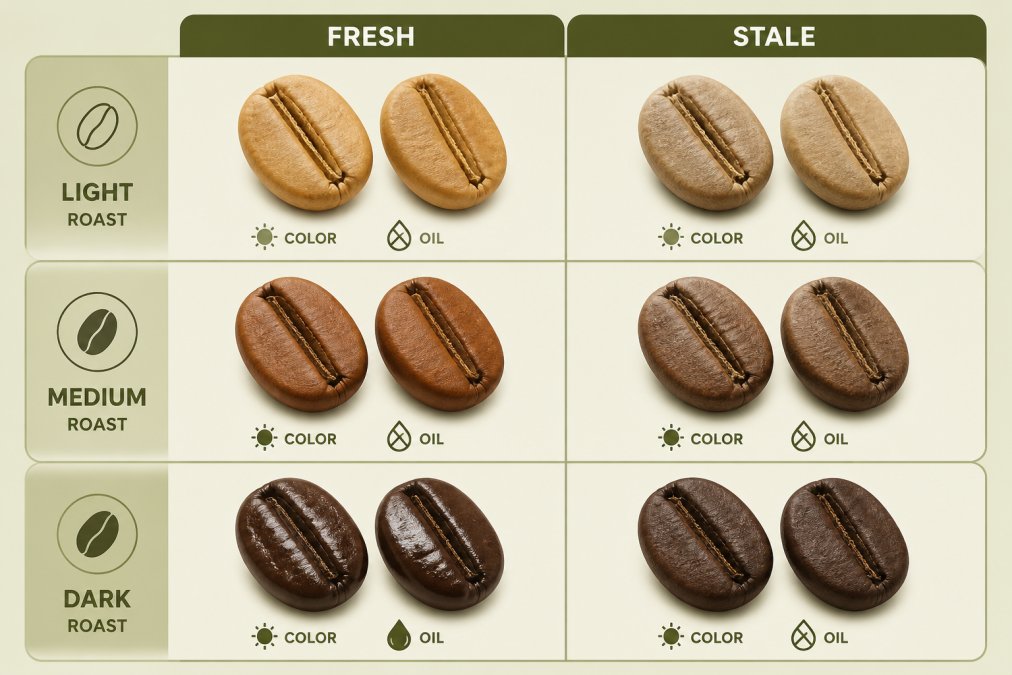
The oily residue on fresh beans is a positive sign, not a problem. That's degassing, the natural release of carbon dioxide that happens after roasting.
Dullness is the opposite signal. A papery or dull appearance means the beans have lost moisture and the volatile compounds that create flavor. They're oxidizing, which degrades the taste profile.
The Aroma Test for Freshness
Your nose is one of your most accurate freshness detectors. Fresh coffee has a strong, fragrant aroma. Stale coffee has little to no smell.
Open a bag of fresh beans and take a deep breath. You should get hit with a clear coffee aroma, rich, complex, sometimes fruity or chocolatey depending on the origin. The smell should be immediate and noticeable.
With stale beans, you might smell something, but it's muted. The aroma is flat and lacks depth. Sometimes there's a slightly off or rancid note, which indicates oxidation is underway.
The aroma test works because:
- Volatile compounds create smell
- Fresh beans release these compounds easily
- Stale beans have lost most of these compounds
- Oxidation creates different, less pleasant aromatic notes
This test requires no equipment. Just open the bag and smell. Your senses will tell you the story.
For single-origin beans like our Colombia or Ethiopia Natural, aroma is particularly telling. Fresh Colombian beans smell like dried orange and chocolate. Fresh Ethiopian beans have fruity, caramel notes. If those characteristics are missing or muted, the beans have lost freshness.

Perform the Coffee Bloom Test During Brewing
The bloom test happens during your first pour. It's one of the most revealing freshness indicators because it shows CO2 activity in real time.
When you pour hot water over fresh grounds, they bubble and expand immediately. This is degassing, the release of carbon dioxide trapped in the beans. A vigorous bloom is a sign of freshness. The more active the bloom, the fresher the beans.
How to perform the bloom test:
- Grind your beans to medium consistency
- Place grounds in your brewing device (pour-over, French press, etc.)
- Pour just enough hot water to wet the grounds
- Watch for 30-45 seconds
- Observe the bubbling and expansion
Fresh beans bloom aggressively. You'll see visible bubbles and the grounds will rise noticeably. The bloom lasts several seconds and is obvious.
Stale beans produce little to no bloom. The grounds might bubble slightly, but there's no real expansion or activity. The bloom dies quickly or doesn't happen at all.
This happens because fresh beans still have significant CO2 inside. As time passes and the beans sit, that CO2 escapes naturally. By the time the beans are stale, most of it is gone.
The bloom test is particularly useful because it happens during your normal brewing routine.
How to Store Coffee Beans for Maximum Freshness
Storage directly determines how long your beans stay fresh. The wrong storage method accelerates staleness, but even with perfect storage, beans have a finite freshness window. Understanding both how to store properly and how to extend the life of aging beans gives you maximum value from every purchase.
Best storage practices:
- Use an airtight container (not the original bag if it's not resealable)
- Keep the container in a cool, dark place (pantry, cabinet, drawer)
- Avoid direct sunlight and heat sources
- Do not store in the refrigerator or freezer (temperature fluctuations cause condensation)
- Keep away from strong-smelling foods (coffee absorbs odors)
When to actually discard beans:
Taste Profile Indicators of Stale Coffee
Your palate tells the truth about freshness. Stale coffee has unmistakable flavor signatures.
Fresh coffee tastes:
- Vibrant and punchy
- Complex, with distinct notes (chocolate, fruit, nuts, etc.)
- Smooth and balanced body
- Bright acidity that's pleasant, not harsh
- Sweet undertones
Stale coffee tastes:
- Flat and one-dimensional
- Muted flavor with little complexity
- Thin, weak body
- Papery or hollow notes
- Bitter or rancid edge
- Lack of sweetness
Frequently Asked Questions
What is the 15-15-15 coffee rule?
The 15-15-15 rule is a guideline for optimal coffee freshness: use beans within 15 days of the roast date, grind 15 minutes before brewing, and brew with water at 15 degrees below boiling (around 195-205°F). This window captures the peak flavor window when carbon dioxide degassing is complete but oxidation hasn't compromised the beans' complexity and aroma.
How long does coffee stay fresh after it's ground?
Ground coffee begins losing flavor within 15-30 minutes of grinding as carbon dioxide and volatile aromatic compounds escape rapidly. For best results, grind immediately before brewing. If you must grind ahead, store grounds in an airtight container and use within 30 minutes. Whole beans retain freshness much longer, typically 2-4 weeks from the roast date when stored properly.
Does the roast date on the bag really matter?
Yes, the roast date is far more important than an expiration date. Coffee peaks in flavor 3-7 days after roasting once degassing is complete, and remains fresh for 2-4 weeks. An expiration date may be months away but the beans could already be stale. Always choose bags with a visible roast date within the past 2-3 weeks, and prioritize roasted-to-order options like Al Di Là's single-origin selections for maximum freshness and aroma.
How can you tell if coffee beans are high quality?
High-quality beans show consistent size and color, possess a vibrant aroma, and come from a known origin with a recent roast date. Look for single-origin beans with detailed grower and altitude information. Taste indicators include clarity in flavor profile (distinct notes rather than flat or hollow taste), balanced acidity and body, and no rancid or papery notes. Premium roasters like Al Di Là provide tasting profiles so you know what to expect before brewing.
The easiest way to guarantee fresh beans is to start with a roaster who prioritizes freshness. Al Di Là roasts to order and ships quickly, so your beans arrive at peak freshness. Our single-origin options like Brazil Santos, Colombia, and Guatemala all showcase their best qualities when brewed fresh. Start with a bag and apply these freshness tests yourself. You'll taste the difference immediately.