

How to Brew Better Coffee at Home: A Complete Guide
Table of Contents
- The Foundations of Better Home Coffee Brewing
- Best Coffee Brewing Methods and How They Work
- Coffee Grind Size for Brewing Methods
- Best Water Temperature for Coffee Extraction
- Getting the Coffee-to-Water Ratio Right
- Choosing and Storing Quality Coffee Beans
- Troubleshooting Common Brewing Problems
- Frequently Asked Questions
Last Updated: October 12, 2026
The Foundations of Better Home Coffee Brewing
To brew better coffee at home, focus on four core variables: bean freshness, grind size, water temperature, and brew time. Most people focus on only one or two, which explains why their coffee tastes inconsistent.
Fresh beans matter more than anything else. This is why Al Di Là roasts beans to order, maximum freshness and aroma reach your cup, not a warehouse shelf.

Water quality is underestimated. Tap water often contains chlorine, minerals, or sediment that interfere with extraction. Filtered water removes these obstacles and lets the coffee's actual flavors come through.
Temperature and timing create extraction. Too hot, too long, or too fine a grind pulls bitter compounds; too cool, too short, or too coarse pulls sour notes.
Best Coffee Brewing Methods and How They Work
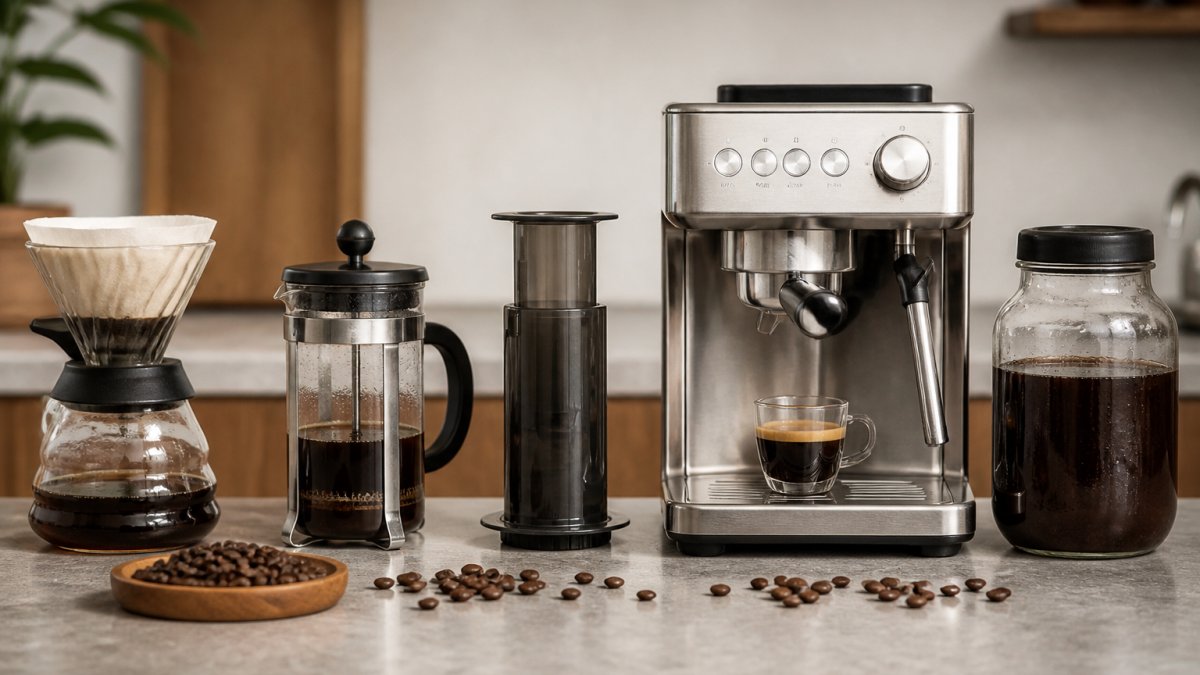
Different brewing methods extract coffee differently, so the same beans can taste completely different depending on how you brew them. Understanding each method helps you pick one that matches your schedule, preferences, and budget.
Pour-Over Brewing
Pour-over gives you direct control over water temperature, pour speed, and brew time. Place a filter over a cup or carafe, add medium-fine grounds, and slowly pour hot water over them. The process takes about 3-4 minutes.
Pour-over produces a clean cup because paper filters trap oils and fine particles that would otherwise make the coffee taste muddy. If you prefer bright, crisp flavors with clarity, this method delivers. The downside is that it requires attention and technique: pouring too fast or slow, or using water that's too hot or cool, noticeably changes the result.
French Press (Cafetière)
A French press is a cylindrical vessel with a plunger and metal mesh filter. Add coarse grounds, pour hot water over them, steep about 4 minutes, then press the plunger down. The metal filter allows coffee oils through, creating a fuller, richer body than pour-over.
French press is forgiving and consistent with minimal technique. The trade-off is a slightly heavier, muddier cup because fine particles pass through the metal mesh. If you like bold, full-bodied coffee and don't mind sediment, it's an excellent choice, and it brews larger quantities at once.
Drip Coffee Makers
Automatic drip machines heat water and pass it through grounds into a carafe. Load grounds into the filter basket, add water to the reservoir, press a button, and the machine handles the rest, brewing 5-12 cups in 5-10 minutes.
Drip machines trade control for convenience. You can't adjust temperature or pour speed mid-brew, so consistency depends on the machine's quality and your grind size. Cheaper machines brew too hot or too fast, leading to bitter coffee; better machines maintain stable temperature and brew time. If convenience matters more than precision, a quality drip machine is practical, just avoid the cheapest models.
AeroPress and Espresso
An AeroPress is a manual device that uses air pressure and immersion. Add fine grounds and hot water to a chamber, wait 10-30 seconds, then press the plunger to force the coffee through a paper filter. It takes 1-2 minutes and produces a small, concentrated cup.
Espresso machines force hot water through finely ground coffee under high pressure, extracting a small amount of intensely concentrated liquid. True espresso requires significant equipment investment and technique, temperature, pressure, and grind size must all be precise.
Both methods produce strong coffee and require attention to detail. For a quick, flavorful single cup, AeroPress is accessible and affordable. For espresso drinks regularly, a quality machine is worth the investment, though the learning curve is steeper.
Cold Brew
Cold brew steeps coarse grounds in cold water for 12-24 hours, then filters them out. The result is a smooth, naturally sweet concentrate you dilute with water or milk. It's less acidic than hot-brewed coffee because cold water extracts fewer acidic compounds (Physiochemical Characteristics of Hot and Cold Brew Coffee Chemistry).
Cold brew requires planning but is nearly impossible to mess up, since cold water can't over-extract. The concentrate keeps two weeks refrigerated, so you can brew once and enjoy multiple cups. If you prefer smooth, mellow coffee, cold brew is ideal. Al Di Là's Cold Brew Coffee is specifically blended for this method, with a coarse grind already optimized for steeping.

Coffee Grind Size for Brewing Methods
Grind size controls how fast water passes through coffee and how much surface area is exposed, directly affecting extraction speed and flavor.
A coarse grind has large particles with less surface area, so water passes through quickly and brew time must be longer.
A medium grind is the middle ground, used for drip machines and pour-over. It balances extraction speed and surface area, typically brewing in 3-5 minutes.
A fine grind has small particles with maximum surface area, so water passes through quickly and brew time is short.
Using the wrong grind size produces poor results.
A burr grinder produces consistent particle size. Blade grinders chop randomly, creating uneven sizes that extract unevenly.
Best Water Temperature for Coffee Extraction
Water temperature directly controls how fast extraction happens: hotter water extracts faster, cooler water slower.
The optimal range for most methods is 195-205°F, which extracts the right amount of flavor compounds without pulling too many bitter ones.
Single Origin Favorites Sample Pack →
If your kettle doesn't have a thermometer, a simple rule works: boil water, then wait 30 seconds before pouring.
Some methods vary. Cold brew uses cold water by design. French press tolerates slightly hotter water (up to 210°F) because the metal mesh lets some bitter compounds through anyway and the longer steep is more forgiving.
If your coffee tastes bitter, lower the temperature first. If it tastes sour, raise the temperature. Temperature adjustments often fix flavor problems without any other changes.
Getting the Coffee-to-Water Ratio Right
The coffee-to-water ratio determines how strong or weak the final cup tastes: too much coffee makes it unpleasantly strong, too little makes it thin and watery.
A common starting ratio is 1:16, one part coffee to 16 parts water by weight, so 25 grams of coffee to 400 grams of water.
If you prefer stronger coffee, move to 1:15. If you prefer weaker coffee, move to 1:17 or 1:18.
Measuring by weight is more accurate than by volume, since coffee density varies.
For those without a scale, a rough guideline is one tablespoon of whole beans per 6 ounces of water. This is approximate but close to the 1:16 ratio.
Choosing and Storing Quality Coffee Beans
Coffee quality starts with the bean. Al Di Là's Single Origin Favorites Sample Pack lets you try six origins: Brazil Santos with cocoa notes, Colombia with dried orange and berry, Costa Rica with apple and honey, Ethiopia with fruity caramel, Honduras with spice and brown sugar, and Tanzania with pear and floral notes.
Roast level affects flavor. Light roasts preserve origin flavors and taste brighter and more acidic; medium roasts balance origin and roast flavors; dark roasts emphasize roast flavors and taste heavier and more bitter. There's no "best" roast.
Freshness is critical. Coffee begins losing flavor within two weeks of roasting. Buy beans roasted within the last week if possible, and use them within three weeks. Avoid beans with no roast date listed, they're likely old. Al Di Là roasts to order, so your beans arrive fresh.
Storage matters. Keep beans in an airtight container away from light, heat, and moisture; a sealed bag with a one-way valve works well. Avoid the freezer, since condensation damages beans. Room temperature in a dark cupboard is ideal.
Troubleshooting Common Brewing Problems
Sour coffee usually means under-extraction: the water didn't spend enough time pulling flavors from the grounds.
Bitter coffee usually means over-extraction: the water pulled too many harsh compounds. Fix it with cooler water, a coarser grind, or a shorter brew time.
Weak or watery coffee means too little coffee relative to water. Increase the coffee-to-water ratio, use more grounds or less water.
Muddy or gritty coffee comes from fine particles in the cup, common with French press if the grind is too fine.
Inconsistent results mean one or more variables are changing. Start measuring by weight instead of volume. Use a thermometer to check water temperature. Write down your brew time.
Learning to brew better coffee at home isn't complicated, but it requires attention to detail. The difference between mediocre and excellent coffee comes down to fresh beans, proper grind size, correct water temperature, and the right brew time for your method.
Frequently Asked Questions
What is the best coffee-to-water ratio for home brewing?
The standard ratio is 1:16 (one part coffee to 16 parts water by weight). Start with this baseline: for 8 ounces of water, use 0.5 ounces (about 14 grams) of ground coffee. Adjust slightly stronger or weaker based on your taste preference. Using a kitchen scale ensures consistency and repeatability, which is essential for improving your brew over time.
How fine should I grind coffee for different brewing methods?
Grind size directly affects extraction. Use coarse grounds for French press (like sea salt texture), medium grounds for drip machines and pour-overs (like sand), and fine grounds for espresso (like flour). Cold brew requires coarse grounds and a longer steep time. A burr grinder gives you precise control; blade grinders create uneven particle sizes that lead to inconsistent extraction and muddy or sour coffee.
What water temperature is best for brewing coffee?
The ideal range is 195-205°F. Water hotter than 205°F over-extracts and tastes bitter; cooler than 195°F under-extracts and tastes weak or sour. Let boiling water cool for 30 seconds before pouring, or use a thermometer to check. Consistency in water temperature is as important as the temperature itself, it's one of the easiest variables to control for repeatable results.
Why does my home-brewed coffee taste bitter or sour?
Bitter coffee usually means over-extraction: your grounds are too fine, brew time is too long, or water is too hot. Sour coffee indicates under-extraction: grounds are too coarse, brew time is too short, or water is too cool. Start by adjusting one variable at a time. If you're using pre-ground coffee that's been sitting open, staleness can also create off-flavors, freshly ground beans make a noticeable difference.
How does freshness affect the taste of home-brewed coffee?
Coffee beans peak in flavor 5-14 days after roasting, when CO2 release stabilizes and oils develop fully. Stale beans (more than 4 weeks old) lose aroma and taste flat or dull. Whole beans stay fresh longer than pre-ground coffee. Store beans in an airtight container away from light, heat, and moisture. Al Di Là's roasted-to-order model ensures you receive beans at peak freshness, maximizing flavor extraction.
Do I really need a burr grinder, or will a blade grinder work?
A burr grinder is worth the investment. It produces uniform particle sizes, which means even extraction and consistent flavor. Blade grinders create a mix of fine dust and large chunks; fine particles over-extract (bitter), while large chunks under-extract (weak). Uneven extraction is the main reason home coffee tastes worse than café coffee. A quality burr grinder transforms your brewing results more than any other single tool.
Can I make café-quality coffee at home without expensive equipment?
Yes. The three essentials are fresh beans, a burr grinder, and proper technique (correct ratio, grind size, water temperature, and brew time). A simple pour-over or French press costs $15-30 and produces excellent results when paired with fresh, quality beans and attention to these variables. Expensive equipment helps, but precision in the basics matters far more. Start with fundamentals and upgrade equipment only after mastering technique.