

Is Vacuum Sealing Coffee Beans Worth It?
Last Updated: November 7, 2026
Quick Summary
Vacuum sealing coffee is worth it for most home drinkers who buy beans in bulk or keep a bag open for weeks, because removing air slows the oxygen reaction that makes beans stale. It adds little value if you finish a bag within two or three weeks, since a valve bag or airtight container works just as well.
- Oxygen does most of the damage to coffee beans, and each bag opening lets fresh air in.
- Do not vacuum seal beans within a few days of roasting, because trapped CO2 can swell the bag and weaken the seal.
- Vacuum sealing extends freshness for whole beans held for months, but it only slows staleness rather than stopping it.
- Portion beans into single-use amounts before sealing or freezing, so you never reopen a large bag.
- Grinding to order gives the biggest flavor gain, since ground coffee stales much faster than whole beans.
Table of Contents
- What Vacuum Sealing Does to Coffee Beans
- Vacuum Sealing Versus Airtight Containers and Valve Bags
- How Long Vacuum-Sealed Coffee Beans Stay Fresh
- Freezing and Portioning Before You Vacuum Seal
- Mason Jars, Ground Coffee and Other Common Questions
- Can You Vacuum Seal Ground Coffee?
- Deciding Whether Vacuum Sealing Is Right for Your Coffee Habit
- Frequently Asked Questions
What Vacuum Sealing Does to Coffee Beans
Vacuum sealing coffee is worth it for most home coffee drinkers who buy beans in bulk or keep a bag open for weeks. The real question is how much freshness your beans lose once they leave the roaster and sit in your pantry. The short answer is that oxygen does most of the damage, and removing air slows that process down.
Coffee goes stale mainly because oxygen reacts with the aromatic oils in the bean. To check whether beans you already have are still fresh, see how to tell if coffee beans are fresh. Each time a bag is opened, fresh air rushes in and speeds that reaction. A vacuum sealer pulls most of that air out before the bag is closed, which is why many people find it extends the window in which beans still taste bright.
The trade-off is that vacuum sealing also removes the carbon dioxide that beans release for days after roasting. Freshly roasted coffee continues to degas, and that gas needs somewhere to go. Sealing beans too early can trap it, so beans roasted only a day or two ago are a poor candidate for a vacuum bag.
Vacuum Sealing Versus Airtight Containers and Valve Bags
Vacuum sealing coffee beats a standard open bag, but it is not the only option, and the right choice depends on how the container handles two gases moving in opposite directions. Freshly roasted beans release carbon dioxide for days to weeks after roasting, while oxygen is the main thing you want to keep out. Any storage method is really a negotiation between letting CO2 escape and blocking oxygen entry.
The original one-way valve bag is built around that negotiation. A small silicone or plastic valve opens under slight internal pressure, so CO2 pushes out, then the valve closes and limits oxygen moving back in. That is why most roasters ship in valve bags: the bag self-regulates during the first week or two of degassing without the buyer doing anything. The limitation is that a valve bag is not a hard oxygen barrier.
An airtight container with a gasket lid blocks oxygen well while closed, but it has no way to vent CO2. If you fill it with beans roasted two days ago, pressure builds, and when you open the lid the gas escapes in a rush and room air replaces it. For beans that have already finished degassing, an airtight container is a strong daily-use option because you are not fighting CO2 anymore. For very fresh beans, it can trap gas and create a stale, flat-smelling headspace.
A vacuum-sealed bag removes most of the oxygen and also pulls out the CO2-rich headspace. That is a strong oxygen barrier and a good fit for long storage, but it works against you if the beans are still actively degassing, because the bag can balloon or the seal can weaken as gas accumulates. Vacuum sealing is best applied after the initial degas window, or with a short venting step if you must seal fresh beans.
Here is how the three options compare on the variables that actually change your cup:
| Storage Method | Handles CO2 | Blocks Oxygen | Reopenings Hurt? | Best For |
|---|---|---|---|---|
| One-way valve bag | Vents automatically | Moderate barrier | Yes, each opening exchanges headspace | Beans used within a few weeks of roast |
| Airtight container | Traps gas until opened | Strong while closed | Yes, and trapped gas releases on opening | Daily use, beans past peak degas |
| Vacuum-sealed bag | Removes headspace, can balloon if sealed too fresh | Strong | Yes, but smaller headspace to exchange | Bulk buys, portions held for months |
A valve bag is often the best default for beans you finish within a month, because it handles degassing for you and requires no equipment. If you buy a larger quantity to save money, vacuum sealing portions makes more sense, especially if you divide the beans into amounts you will use in a week or two. To choose beans worth buying for home use, see which specialty coffee beans are worth buying for home.
Watch out: sealing beans that are still actively degassing can cause the bag to inflate and the seal to fail, so if you seal within a few days of the roast date, check the bag after 24 hours and reseal if it has ballooned.
How Long Vacuum-Sealed Coffee Beans Stay Fresh
Vacuum-sealed beans generally keep their flavor longer than beans in an open bag, but the gain is not unlimited. The useful window depends on roast age, whether the beans are whole or ground, and how often the seal is broken. A practical way to think about it is in phases rather than a single shelf-life number.
The first phase is degassing, roughly the first several days to two weeks after roast. During this window the beans are releasing CO2 fast, and vacuum sealing too early fights that process. If you seal during active degas, the bag may balloon and the seal may weaken, and the trapped gas can create a flat, stale-smelling headspace when you open it.
The second phase is peak drinking, often roughly two to six weeks after roast for whole beans stored cool and dark. Vacuum sealing during this phase mainly protects against oxygen ingress between openings. The gain over a valve bag is real but modest if you are finishing the bag within a few weeks anyway.
The third phase is extended holding, where vacuum sealing earns its keep. For whole beans you will not open for one to several months, vacuum-sealed portions stored in a cool, dark place, or frozen, hold their aroma noticeably better than beans in an open or repeatedly opened container. The improvement is a slower decline, not a pause: vacuum sealing extends the window rather than preserving beans indefinitely.
Ground coffee changes the math. Grinding exposes far more surface area to oxygen, so ground coffee declines much faster than whole beans regardless of the seal. Vacuum sealing ground coffee slows the decline but cannot match whole-bean storage, which is why grinding to order remains the single biggest freshness lever.
Storage conditions matter as much as the seal. Heat, light, and moisture degrade coffee faster than oxygen alone. A sealed bag kept in a cool, dark cupboard will outlast one left on a sunny counter by a noticeable margin, and moisture from a humid kitchen or a refrigerator door can undo a good seal.
A practical way to set your own timeline: seal several identical portions on the same day, then taste one every two weeks and note when the aroma turns flat or the acidity dulls. That gives you a personal shelf life that matches your equipment, your palate, and your storage space, rather than a generic claim.
Watch out: if you freeze vacuum-sealed portions, let each portion come fully to room temperature before opening the bag, because condensation on cold beans introduces moisture that no seal can protect against.
Freezing and Portioning Before You Vacuum Seal
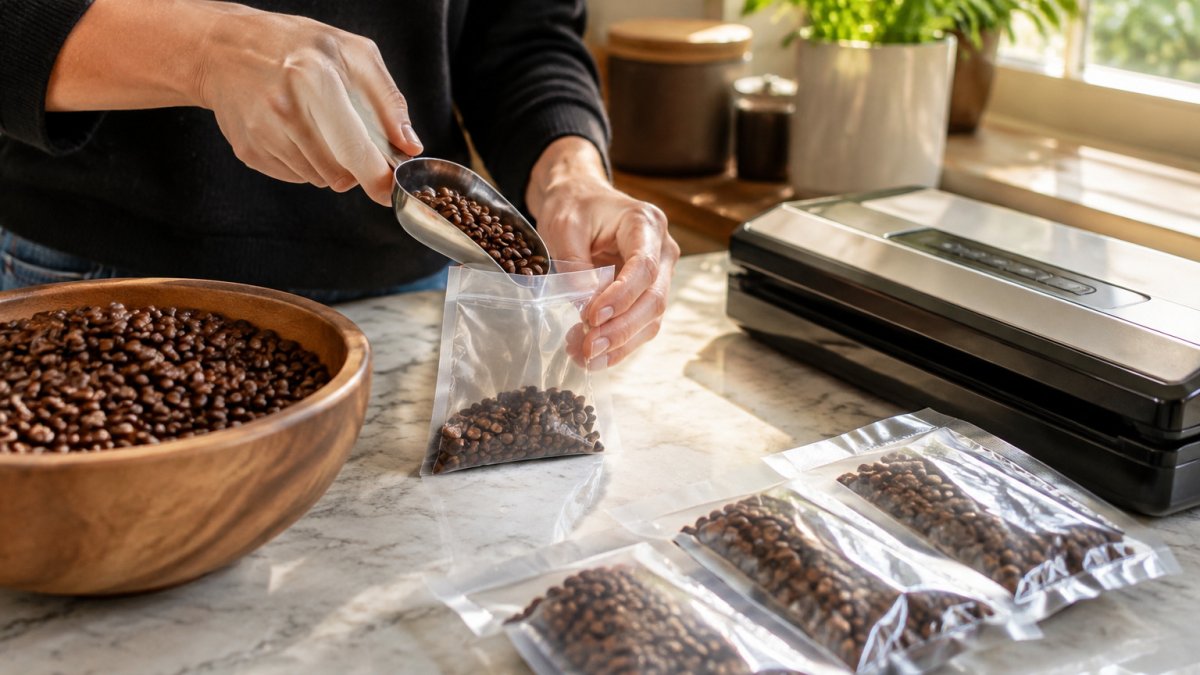
Freezing is a practical option for beans you will not use for several months. The key is to portion the beans into single-use amounts before sealing, so you never reopen a large bag that then gets exposed to condensation.
Divide your beans into the quantity you use per brew, seal each portion, and freeze them flat. Use one portion at a time and let it come to room temperature before opening, which prevents moisture from forming on the beans.
Mason Jars, Ground Coffee and Other Common Questions
Many people ask whether a mason jar with a vacuum pump works as well as a vacuum bag. A vacuum jar can hold a good seal for whole beans, but the glass and lid need to stay airtight, and the pump should be checked regularly for leaks.
Ground coffee is a different case. It has far more surface area exposed to air, so it goes stale much faster than whole beans. Most people who want to keep ground coffee fresh should buy smaller quantities rather than relying on a seal.
Can You Vacuum Seal Ground Coffee?
You can vacuum seal ground coffee, and it will stay fresher for longer than an open bag. The improvement is smaller than with whole beans, though, because the grind has already exposed the coffee's oils to air. Vacuum sealing slows the decline but cannot reverse it.
If you grind to order, you get the most flavor from whole beans. Seal the beans, then grind only what you need for each brew.
Deciding Whether Vacuum Sealing Is Right for Your Coffee Habit
Vacuum sealing makes sense if you buy in bulk, drink coffee slowly, or want to keep a stock of beans for several months. It adds little value if you finish a bag within two or three weeks, since a one-way valve bag or airtight container will do the job.
Start by asking how quickly you go through a bag. If you are unsure whether single origin or blend beans suit your habit, single origin vs blend coffee explained covers the differences. If the answer is more than a month, vacuum sealing portions will likely improve your cups. If you brew daily and finish beans quickly, a simple airtight jar is usually enough.
For readers choosing beans as well as storage, our Single Origin Favorites Sample Pack ($25.99) lets you try several origins in 2oz packs before committing to a full bag. The Best Sellers Sample Pack ($25.99) and the Flavored Coffees Sample Pack ($25.99) let you test which profile suits your palate.
Frequently Asked Questions
Is it a good idea to vacuum seal coffee beans?
For most people, vacuum sealing is worth it only when you buy more beans than you can use within about two weeks, or when you want to store beans for several months. Sealing removes oxygen, which slows staling, but it does not stop the gradual loss of aroma. If you drink a bag within a few weeks of roasting, a sealed airtight container with the original valve bag is usually enough. Vacuum sealing also adds cost in equipment and bags, so weigh that against how much coffee you actually go through.
How long will coffee beans last if vacuum sealed?
Vacuum-sealed whole beans kept at room temperature typically stay in good condition for several months, compared with a few weeks for beans stored loosely in a bag after opening. Ground coffee loses flavor faster, so it benefits less. Results depend on roast date, bean quality and how cool and dark the storage spot is. Check the roast date rather than relying on a fixed number, and seal only what you plan to use within a reasonable window once opened.
Does vacuum sealing keep coffee beans fresh longer?
Yes, removing oxygen reduces oxidation, which is one of the main drivers of staling in roasted coffee. Vacuum sealing is more effective than leaving beans in a half-empty bag, because less air remains around the beans. However, freshly roasted beans still release carbon dioxide during degassing, and a sealed bag can trap that gas. Let beans rest for a few days after roasting before sealing, and avoid sealing beans that are still actively off-gassing.
Can you vacuum seal ground coffee?
You can, but ground coffee gains less from vacuum sealing than whole beans. Grinding exposes far more surface area to air, so staling happens faster, and sealing slows that process only somewhat. Vacuum sealing ground coffee is a reasonable choice if you grind a single batch and want to preserve it for a few extra weeks. For daily use, grinding small amounts just before brewing gives the most noticeable improvement in flavor.
